Best AI Content Detectors Compared: Accuracy, Pricing and Limits (2026)
Choosing the right AI content detector is becoming more important for bloggers, students, teachers, editors, and digital publishers.
With AI writing tools becoming part of everyday work, many people want to know whether a piece of content was written by a human or generated with artificial intelligence.
However, finding a reliable AI detector is not always easy.
The best AI content detectors offer different features, pricing plans, scan limits, and detection methods. Some provide free checks, while others offer detailed sentence-level reports, plagiarism detection, and team features.
Their results can also vary depending on the writing style, text length, and amount of AI assistance used.
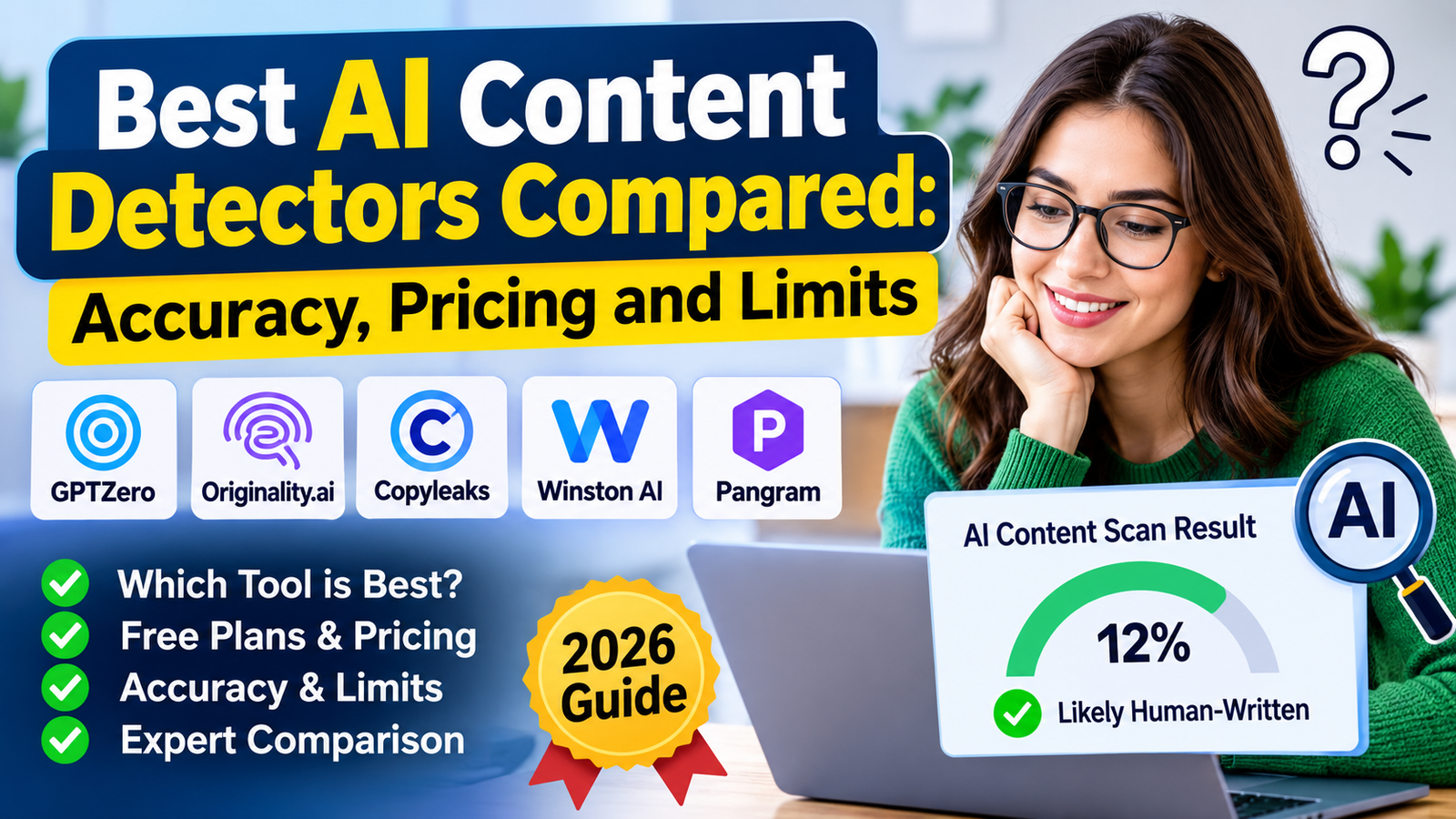
In this guide, we compare popular AI content detection tools, including GPTZero, Originality.ai, Copyleaks, Winston AI, and Pangram.
We will examine their features, available pricing, free plans, and limitations to help you choose the right option for your needs.
What Is an AI Content Detector?
An AI content detector is an online software tool that analyzes written text to estimate whether it was produced by artificial intelligence or a human writer.
These tools examine different language patterns, sentence structures, word choices, and statistical features to generate a detection result.
Most AI detectors provide a percentage score or a classification that indicates whether the submitted text appears human-written, AI-generated, or a mixture of both. Some advanced platforms also highlight individual sentences that may contain AI-generated content.
These tools are useful for content editors, teachers, website owners, and professional writers. However, an AI detection score should not be treated as final proof of authorship.
Even well-written human content can sometimes receive an incorrect AI classification.
Best AI Content Detectors Compared in 2026
The market offers several AI detection platforms, but not every tool provides the same experience.
Some focus on academic writing, while others offer additional features for professional publishing and content management.
The following comparison considers publicly available product information and pricing. It is not a controlled accuracy test performed by this website, so individual results may differ.
1. GPTZero – Best for Students, Teachers and Writers
GPTZero is one of the well-known platforms for checking AI-generated writing. It helps users examine text that may have been created using ChatGPT and other AI writing systems.
The platform is particularly relevant to students, educators, and people who regularly review written assignments.
Its basic AI scan provides an overall detection score, while advanced features offer more detailed sentence-level analysis. GPTZero also provides writing feedback, plagiarism checking, and browser extension features depending on the selected subscription.
The free plan includes 10,000 words per month, a maximum of 10,000 characters per scan, and up to three files in a batch upload. Paid subscriptions increase the scan limits and provide access to additional features.
According to its published pricing information, the Essential plan has been listed at $14.99 per month with monthly billing, while annual billing can reduce the effective monthly cost. Premium and Professional plans offer higher usage allowances and additional tools.
One limitation is that a detection result does not establish who actually wrote a document. Writers who use AI for brainstorming, editing, or improving grammar may also receive mixed results.
Official website: https://gptzero.me/
2. Originality.ai – Best for Bloggers and Content Publishers
Originality.ai is designed for website owners, SEO professionals, agencies, and content publishers who want to review content before publishing it. It combines AI detection with additional content quality features, making it useful for professional publishing workflows.
The platform offers AI content detection, plagiarism checking, readability analysis, and other writing-related features. These options can help editors review articles and identify sections that deserve additional attention.
Originality.ai provides a free option with three scans per day and a limit of 2,000 words per scan. Its Pro subscription is listed at $14.95 per month with monthly billing or an effective $12.95 per month when billed annually. The annual option includes 2,000 credits per month.
Its paid features make it worth considering for bloggers who manage several writers or publish articles regularly. However, users should understand how its credit system works before purchasing a subscription.
Another important limitation is that an AI detection percentage cannot independently determine content quality, originality, factual accuracy, or whether an article provides genuine value to readers.
Official website: https://originality.ai/
3. Copyleaks – Best for Multilingual AI Content Detection
Copyleaks is a content analysis platform that offers AI detection and plagiarism checking. It is particularly interesting for educational institutions, professional teams, and businesses that review documents in multiple languages.
The platform supports AI content detection in more than 30 languages, according to its published product information. It also offers plagiarism detection, browser extensions, document scanning, and integrations with other services.
Its Personal subscription is listed at $16.99 per month with monthly billing or $13.99 per month when billed annually. The monthly plan includes 100 unified credits, while the annual plan includes 1,200 credits.
The credit system supports different scanning needs, so users should check the word and image allowances before choosing a plan.
Copyleaks can be a useful choice for organizations that need more than a basic AI checker. Its multilingual capabilities are especially relevant when reviewing content written for international audiences.
However, its broader feature set may be unnecessary for someone who only wants to check a short blog post occasionally. Users should also avoid treating its detection score as conclusive evidence of AI authorship.
Official website: https://copyleaks.com/
4. Winston AI – Best for Detailed Content Reports
Winston AI provides AI detection features for writers, educators, publishers, and businesses. Its platform focuses on analyzing written content and presenting results in a format that users can review more easily.
The service supports sentence-level AI detection and allows users to paste text or upload documents. Depending on the subscription, users can also access plagiarism checking, shareable PDF reports, file scanning, and team collaboration features.
Winston AI offers a free starting option with 2,000 credits. Its published Essential plan is listed at $12 per month when billed annually, with 80,000 monthly credits. The Advanced plan is listed at $20 per month when billed annually and includes 200,000 monthly credits.
The Team plan offers shared credits and additional collaboration features for organizations that need multiple accounts. These options make Winston AI relevant for agencies and educational teams.
Its main limitation is that free usage is restricted, while advanced reporting and plagiarism features require a paid subscription. The actual usefulness of a report also depends on how carefully the results are interpreted.
Official website: https://gowinston.ai/
5. Pangram – Best for Multilingual Detection and Professional Review
Pangram is an AI detection platform that focuses on identifying AI-generated and human-written content. It is suitable for researchers, editors, educational users, and professional writers who want additional information about how text may have been produced.
One of its useful features is its ability to detect AI-assisted writing in multiple languages. Its free plan offers up to 2,000 words per day, along with browser extension access, document uploads, and Google Docs integration.
The published Individual subscription is listed at $20 per month and includes up to 300,000 words per month. Its Professional plan is listed at $65 per month and provides a higher usage allowance and additional features.
Pangram is worth considering for users who need larger monthly scanning limits. Its language support can also be useful for international content teams.
However, the availability of advanced features and subscription limits should be checked before purchasing. Like other AI detectors, it should be used as a supporting review tool rather than the only method for judging authorship.
Official website: https://www.pangram.com/
Best AI Content Detectors AI Content Detector Pricing Comparison
Pricing is an important consideration when choosing an AI content detection service. A free tool may be enough for occasional checks, while professional publishers may need larger monthly allowances and advanced reports.
The following figures are based on the providers’ published pricing pages checked in November 2026. Prices are in US dollars and may change.
| AI Detector | Free Option | Paid Starting Price |
|---|---|---|
| GPTZero | 10,000 words/month | $14.99/month |
| Originality.ai | 3 scans/day | $14.95/month |
| Copyleaks | Limited free access | $16.99/month |
| Winston AI | 2,000 starting credits | $12/month annually |
| Pangram | 2,000 words/day | $20/month |
The listed starting prices do not represent identical subscription packages. Each provider uses different credits, word allowances, scan limits, and billing conditions. Therefore, comparing the price alone may lead to the wrong decision.
For occasional personal use, a free plan can be a sensible starting point. Businesses and publishing teams should consider monthly scanning volume, document uploads, reporting options, and collaboration features before committing to a subscription.
Which AI Content Detector Is the Most Accurate?
Accuracy is one of the most important factors when comparing AI detection platforms. However, there is no single accuracy percentage that applies to every document, writing style, language, or AI model.
An AI detector may identify fully AI-generated text correctly but struggle with writing that combines human editing and AI assistance. Short paragraphs, technical documents, translated text, and heavily revised content can also produce different results.
A September 2025 working paper from the National Bureau of Economic Research examined Pangram, Originality.ai, GPTZero, and an open-source detector.
It evaluated false positives and false negatives across a large collection of human and AI-generated writing. The research highlighted meaningful differences between detectors and the importance of considering both types of errors.
You can read the research here: https://www.nber.org/papers/w34223
A 2025 study published in Advances in Simulation also compared several AI detection tools across different writing conditions.
The researchers found that the tools could distinguish different levels of AI involvement, but their scores varied considerably. This shows why users should be careful when interpreting individual detection results.
Research source: https://doi.org/10.1186/s41077-025-00396-6
A good AI detection platform should provide useful evidence, transparent reporting, and clear limitations. Users should not choose a service simply because its website advertises a very high accuracy percentage.
Important Limitations of AI Content Detectors
AI detection technology has improved, but it still has limitations. Understanding these issues can prevent unnecessary subscription costs and incorrect decisions.
False Positive Results
A false positive happens when a detector identifies human-written text as AI-generated. This can be frustrating for students, freelance writers, and website owners who have written their content themselves.
Simple sentence structures, predictable vocabulary, and formal writing styles may influence detection results. Therefore, a high AI score does not automatically mean that a person used an AI writing tool.
False Negative Results
A false negative occurs when AI-generated text is classified as human-written. This means that a detector can miss some AI-generated passages, even when the content contains patterns associated with automated writing.
Different AI models and editing methods can affect the results. A detector that performs well on one type of text may not perform equally well on another.
Short Text Can Produce Unstable Results
Many AI detectors work better when they have enough text to analyze. A short paragraph may not provide sufficient language patterns for a reliable assessment.
For this reason, users should follow each platform’s recommended minimum text length. They should also avoid making important decisions based on a very short sample.
Human Editing Can Change Detection Scores
Writers often edit AI-assisted drafts by adding examples, changing sentence structures, correcting facts, and including personal experience. These changes can influence how a detector evaluates the final document.
The same issue can occur when human-written content receives AI-based grammar or editing assistance. A detection tool may not always distinguish between different levels of involvement.
Different Tools Can Give Different Results
Two AI detectors can analyze the same document and produce different percentages. This happens because each platform uses its own detection methods, models, thresholds, and evaluation processes.
A difference between two scores does not necessarily mean that one tool is broken. It may reflect the different ways each detector interprets the submitted writing.
How to Choose the Right AI Content Detector
The best choice depends on what you want to achieve. A student checking a short assignment has different requirements from a publisher reviewing hundreds of articles every month.
Bloggers and SEO professionals may prefer Originality.ai because it combines AI detection with other content review features. Students and teachers may find GPTZero useful because of its academic focus and sentence-level analysis.
Businesses working with international documents may consider Copyleaks or Pangram because of their multilingual capabilities. Winston AI is another option for teams that need detailed reports and document review features.
Before purchasing any subscription, test the free version with different types of writing. Check its scan limits, supported languages, privacy policy, and cancellation conditions.
It is also important to consider whether the platform stores submitted documents and how it handles user data. This matters when reviewing unpublished articles, client documents, academic assignments, or confidential business information.
Are Free AI Content Detectors Worth Using?
Free AI content detectors can be useful for people who only need occasional checks. They allow users to explore a platform without immediately paying for a monthly subscription.
However, free plans often have restrictions. These may include limited daily scans, maximum word counts, fewer reporting features, and restricted document uploads.
A free tool may be sufficient for checking a short article or testing a paragraph. Professional content teams may eventually need paid subscriptions because they regularly review larger documents and require additional reporting features.
The most practical approach is to compare free plans before paying. You should also check whether the free version offers the same detection model as the paid version, because some platforms reserve advanced analysis for subscribers.
Can AI Detectors Guarantee 100% Accuracy?
No AI content detector can guarantee perfect results for every document. Detection systems estimate the likelihood of AI involvement by examining patterns in written language.
A high score should be treated as a signal for further review rather than a final judgment. Similarly, a low score does not prove that a document was written entirely by a human.
If you are a teacher, editor, or publisher, consider additional evidence such as document history, writing drafts, source references, and direct communication with the writer.
For bloggers, the more important goal should be publishing accurate, original, helpful content that meets readers’ needs. AI detection results alone cannot measure whether an article is genuinely useful.
Final Verdict: Which AI Content Detector Should You Choose?
The best AI content detector depends on your budget, writing needs, and expected scanning volume. GPTZero is worth considering for students and educators, while Originality.ai is a strong option for bloggers and professional content publishers.
Copyleaks is relevant for multilingual document review, Winston AI offers useful reporting and team features, and Pangram provides a generous free daily word allowance with multilingual support.
Before choosing a paid subscription, compare the free plans and test each platform with different writing samples. Do not rely on one percentage score to make important decisions about authorship.
Most importantly, remember that AI detection is an imperfect technology. Use these tools to support content review, not to replace human judgment. The right platform should help you make better decisions without creating unnecessary confusion or false accusations.
Frequently Asked Questions
1. What Is the Best AI Content Detector in 2026?
There is no universally best AI detector for every situation. GPTZero, Originality.ai, Copyleaks, Winston AI, and Pangram offer different features and pricing options. Your best choice depends on your content type, budget, and scanning requirements.
2. Are Free AI Content Detectors Accurate?
Free AI detectors can provide useful initial assessments, but their results are not guaranteed to be correct. Some free plans also have lower scan limits and fewer advanced features than paid subscriptions.
3. Can AI Detectors Identify ChatGPT Content?
Many AI detection platforms are designed to identify patterns associated with ChatGPT and other generative AI systems. However, their performance can vary depending on the model, writing style, and amount of human editing.
4. Can Human-Written Content Be Flagged as AI?
Yes. AI detectors can produce false positive results, meaning they may incorrectly classify human-written content as AI-generated. This is why detection scores should never be treated as definitive proof of authorship.
5. Do AI Content Detectors Offer Monthly Subscriptions?
Yes. Several platforms offer monthly and annual subscriptions. GPTZero, Originality.ai, Copyleaks, Winston AI, and Pangram provide different plans with varying scan limits and features. Always check the official pricing page before purchasing.